Education App Revenue Hits $7.27B: What’s Actually Working in Mobile Learning

Education apps generated $6.3 billion in revenue during 2024, with 2025 figures showing the market hit $7.27 billion – a 15% jump that proves mobile learning isn’t just surviving the AI disruption, it’s evolving. As we move through early 2026, the question isn’t whether education apps work, but which strategies separate winners from failures.
The market is heading toward $33.5 billion by 2033 at a 21% compound annual growth rate. That’s not hype – that’s sustainable momentum driven by AI integration, government digital education initiatives, and lifelong learning demand.
The Duolingo Dominance Continues
One company still towers above the rest. Duolingo generated $748 million in revenue for full-year 2024, representing 40.8% year-over-year growth. By Q3 2025, the company reached 103 million monthly active users and 34.1 million daily active users – a 51% increase in DAU.
| Metric | 2024 | 2025 Growth | Status |
| Revenue | $748 million | +40.8% YoY | Accelerating |
| Monthly Active Users | 103 million | +36% | Record high |
| Daily Active Users | 34.1 million | +51% | Strong engagement |
| Paid Subscribers | 8+ million | +50% annually | Sustained conversion |
The numbers reveal sustainable monetization. Duolingo’s paid subscriber base has grown over 50% annually for five consecutive years. That’s not a temporary spike – that’s a business model proving itself year after year.
What makes Duolingo work? Gamification that feels natural, not forced. Users compete in leagues, maintain streaks, and genuinely care about progress. The company obsessively tests every element to optimize learning curves using real data, not assumptions.
“Our 54% year-over-year growth in daily active users was driven by a record number of net daily user additions. Our DAU-to-MAU ratio, a measure of user engagement, reached a record high thanks to the thousands of product improvements that have compounded over time.” – Luis von Ahn, Duolingo CEO, Q3 2025
The 2025 Market Shift
The $7.27 billion 2025 market shows clear trends:
- North America accounts for 46% of global education app spending despite representing a fraction of users. The revenue concentration in wealthy markets means developers optimize for American and European users willing to pay premium subscriptions.
- Over 103,000 new education apps launched in 2025 alone across iOS and Android, showing sustained developer confidence despite AI chatbot threats. Education remains the second-largest category on Google Play and third-largest on the App Store.
- K-12 apps dominate with 45% market share, driven by digital learning adoption in schools. Professional development represents the fastest-growing segment at 14.2% CAGR as workers demand continuous upskilling.
What Actually Works in 2026
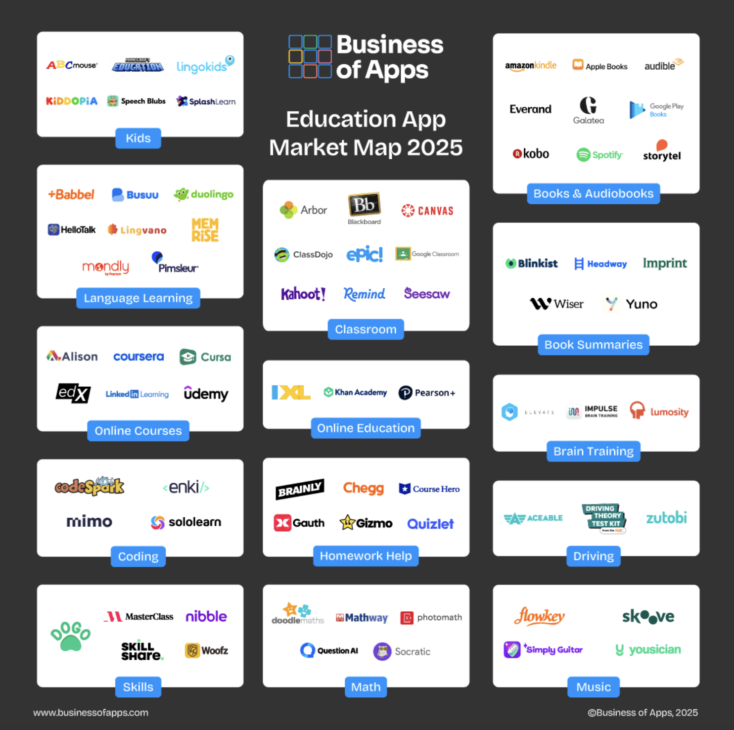
Apps succeeding now share specific characteristics that separate them from the 100,000+ competitors:
- Engagement loops over content dumps.
Users don’t want digital textbooks. They want bite-sized lessons (5-10 minutes), immediate feedback, progress tracking, and daily motivation. Duolingo’s lessons take minutes, not hours. Users finish feeling accomplished, not exhausted.
- Freemium models executed correctly.
Successful apps offer genuinely useful free tiers that convert users naturally. Duolingo’s free tier teaches languages effectively. The paid tier ($7-14/monthly) removes ads, adds offline access, and provides unlimited hearts. The conversion rate hovers around 7-8% of monthly active users – small percentage, massive revenue.
- AI integration that enhances, not replaces.
In 2025, Duolingo adopted an “AI-first” strategy, using generative AI to add 148 new language course configurations in under one year. That’s faster than the first 100 courses took (12 years). But AI supplements human course creators – it doesn’t replace the learning experience itself.
- Data-driven obsessive testing.
Duolingo runs constant A/B tests on lesson design, UI elements, notification timing, and feature placement. This isn’t guesswork – it’s measurement. The company knows exactly what keeps users engaged because it tracks everything.
The AI Disruption Reality Check
ChatGPT and similar AI chatbots created an existential threat to study-help apps in 2024-2025. Why pay for homework assistance when AI answers questions for free? Education apps that simply provided answers saw usage collapse.
But apps offering structured learning experiences thrived. AI chatbots explain concepts, but they don’t provide curriculum, track progress, or maintain engagement over months. Duolingo’s AI integration enhances its core product without cannibalizing value.
The 2025 lesson: AI kills apps that were glorified answer generators. It strengthens apps that genuinely teach through structured, engaging experiences.
- What died: Homework help apps, simple Q&A services, generic tutoring platforms.
- What survived: Structured courses, gamified learning, personalized curriculum, progress tracking.
Government Initiatives Driving Growth
Government digital education programs are accelerating adoption globally. Estonia launched the “AI Leap” program in September 2025, integrating smartphones and AI tools in classrooms with personal AI accounts for 58,000 students and 5,000 teachers by 2027.
In March 2025, Nigeria launched MySlates, a curriculum-aligned educational app offering offline access, multimedia lessons, and AI-driven quizzes tailored to the Nigerian curriculum. These government-backed initiatives legitimize education apps and drive mainstream adoption.
Google unveiled “Gemini for Education” in July 2025, offering schools free access to its Gemini 2.5 Pro AI model through Workspace for Education. Features include interactive diagrams, personalized quiz creation, and automated summaries – all free to educational users.
The Download vs Revenue Paradox
Duolingo had 175 million downloads in 2024, generating $448 million in in-app revenue that year. That’s roughly $2.56 per download over a user’s lifetime – seemingly low until you realize most apps earn pennies.
The freemium model means millions use Duolingo free while a smaller percentage pays. Only 7-8% of monthly active users subscribe to premium. That small percentage generates hundreds of millions because the company retains subscribers effectively.
Lesson: You don’t need everyone to pay. You need enough people valuing your service to subscribe – and staying subscribed.
Business Models That Work
| Revenue Stream | Example | % of Market | Effectiveness |
| Subscriptions | Duolingo Plus | 65-70% | High retention |
| One-time purchases | Course bundles | 15-20% | Lower LTV |
| Advertising | Free tier monetization | 10-15% | Supplementary |
| Institutional licenses | School/corporate | Growing | Stable revenue |
Subscriptions drive most successful education apps. Duolingo’s bookings were 77% subscription-based in 2023. But diversification matters – advertising and the Duolingo English Test (over $40 million in 2023) provide revenue stability.
The 2026 Outlook
The market is projected to reach $33.5 billion by 2033, but near-term growth looks like this:
- 2026 projection: $8-9 billion (moderate growth).
- 2027 projection: $10-12 billion (steady expansion).
- 2028 projection: $14-16 billion (accelerating adoption).
Growth drivers include AI personalization, expansion in emerging markets with government support, professional development demand, and integration with formal education systems.
Headwinds include AI chatbot competition for simple Q&A tasks, subscription fatigue, and economic pressures reducing discretionary spending.
The Bottom Line
The education app market reached $7.27 billion in 2025 by figuring out what works: gamification, correctly executed freemium models, obsessive optimization, and genuine value delivery. Duolingo leads because it mastered all of these while competitors excelled at maybe one or two.
Free AI chatbots didn’t kill education apps. They killed bad education apps – the ones that were glorified answer repositories with no engagement strategy. Good education apps got stronger by integrating AI thoughtfully while maintaining what made them valuable: structured learning experiences that keep users coming back.
For developers entering the market in 2026, the lesson is clear: technology enables better education apps, but it doesn’t replace the fundamental work of creating engaging, effective learning experiences. Users will pay for apps that genuinely help them learn, make learning enjoyable, and fit seamlessly into daily life.