
Biological Age Trackers: Are You Aging Faster Than Your Friends?

We have all experienced that moment of scrolling entirely too far down a drop-down menu to find our birth year. But as of April 2026, the fitness app industry has decided that your actual birthday is officially irrelevant.
Welcome to the era of biological age tracking. Today, your smartphone does not care how many candles were on your last cake. It cares about your cellular health. It calculates your biological age – a dynamic measurement of how your cells and organs are currently functioning compared to the general population.
Instead of relying on vague wellness advice, the current generation of mobile applications leverages clinical algorithms, artificial intelligence, and rigorous physical testing.
Here is a highly detailed, no-nonsense breakdown of how the top four apps of 2026 calculate your internal age, and exactly what they require from you.
The 2026 Heavyweight Longevity Apps
If you want to know how fast you are aging, you need to choose your methodology. Here is how the market leaders operate.
1. SuperAge: The Clinical Data Cruncher
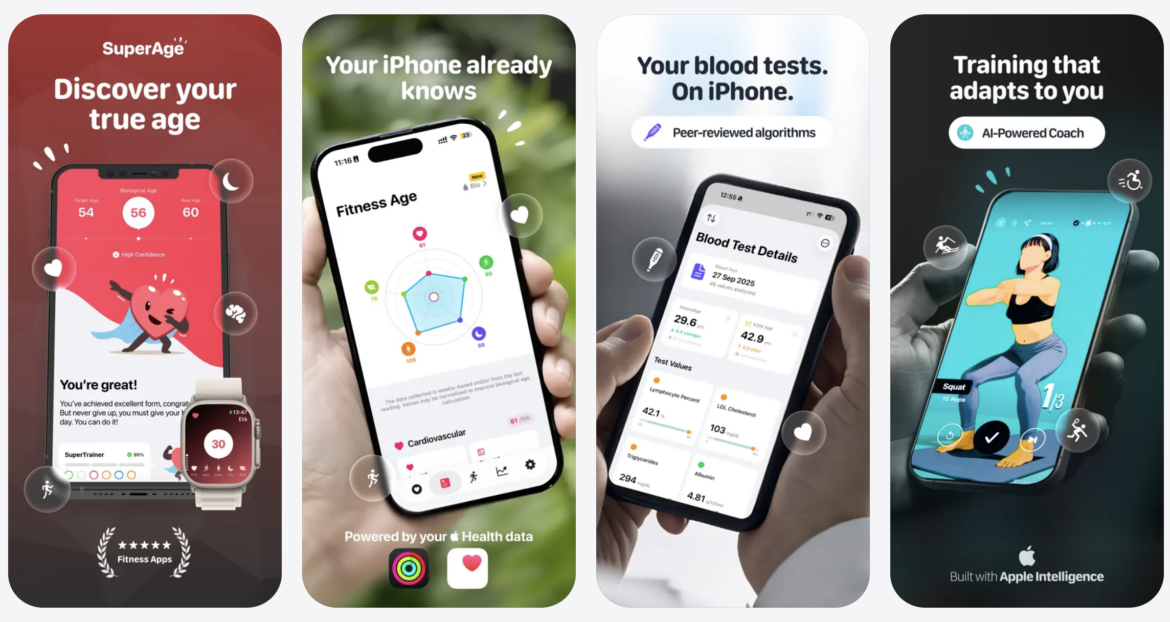
SuperAge does not just rely on your smartwatch guessing your metrics in the background. It is designed for data nerds who want clinical-level insights integrated with their daily routine.
- Blood Test Integration: The standout feature is the ability to upload your raw blood test PDFs directly into the app. The AI extracts your specific biomarkers across multiple domains: hepatic, metabolic, cardiovascular, renal, and inflammatory.
- The Scientific Algorithms: It runs your blood data through established scientific longevity models, specifically the PhenoAge and KDM algorithms, to calculate your true cellular age.
- SuperTrainer: The app features an adaptive, on-device AI that creates workout plans based on your daily biological age readiness score, adjusting the intensity if your central nervous system needs recovery.
2. Myworkout: The VO2 Max Validator
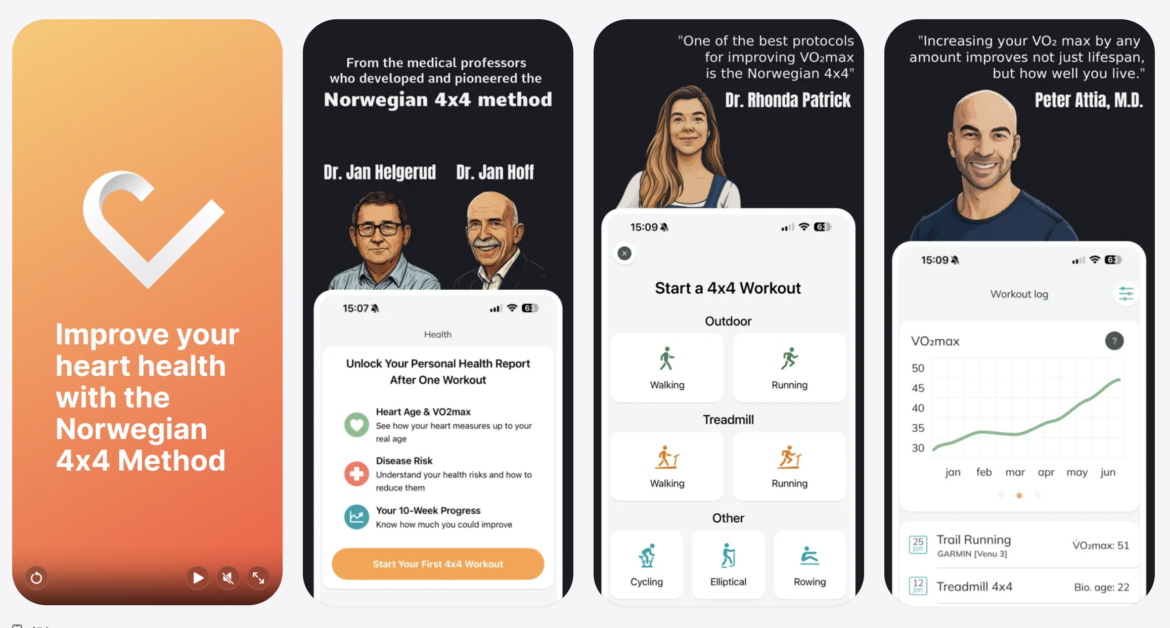
Most wearables estimate your cardiovascular fitness based on your walking heart rate. Myworkout forces you to actually prove it. Backed by clinical research from the Norwegian University of Science and Technology, this app is a highly accurate cardiovascular risk estimator.
- The 4×4 Method: To get your biological age, the app requires you to get on a treadmill (at a minimum 5% incline) and perform four intervals of four-minute high-intensity running.
- The Output: Instead of relying on a heart rate monitor, the app measures the physical work completed (speed and incline) during that specific HIIT session to calculate a scientifically accurate VO2 Max and corresponding biological age.
3. Don’t Die App: The Physical Mobility Tester
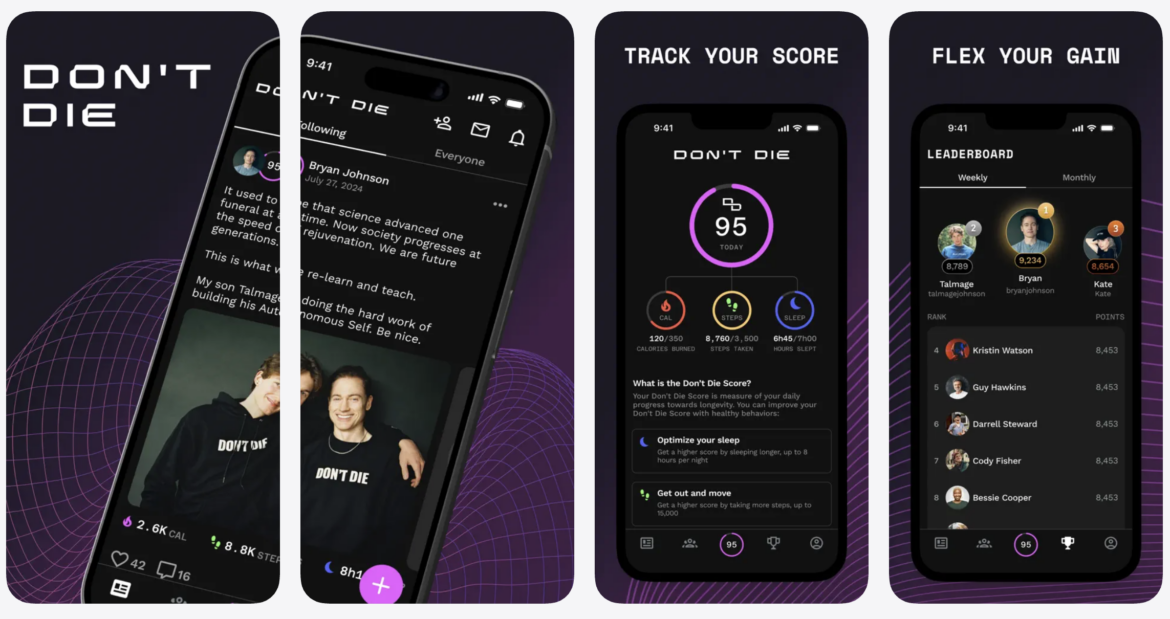
Spawned from the “Blueprint” longevity community spearheaded by Bryan Johnson, this app gamifies the aging process by testing your actual physical resilience.
- Physical Stress Tests: To get an accurate biological age, you must complete and log specific physical benchmarks. This includes a “Sit-Rise Test” (sitting cross-legged on the floor and standing up without using your hands, knees, or arms) and a 10-second blindfolded one-leg stand to prove your neurological balance.
- The Daily Score: It pulls data from Apple Health, Whoop, Fitbit, and Oura, combining those background metrics with your physical mobility scores to generate a daily, gamified “Don’t Die Score.”
4. My Bio Age: The On-Device AI Interrogator
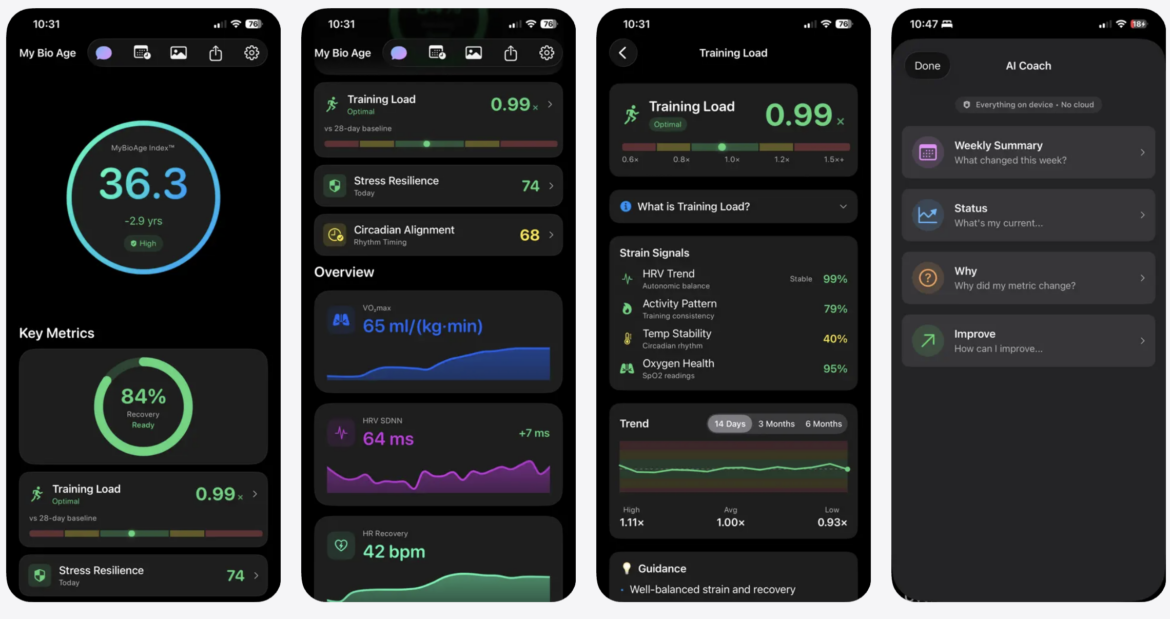
If you want to know exactly why your score changed without compromising your privacy, My Bio Age is the current standard for iOS users. It creates a “MyBioAge Index” by combining 12 core metrics, including Circadian Alignment, Recovery Capacity, and Stress Resilience.
- On-Device Chat: The app features a native AI assistant running locally on your phone using language models like Llama 3.
- Conversational Insights: You can literally type, “Why did my biological age increase this week?” The AI reads your local Apple Health data and explains that your sleep architecture suffered, which dropped your Heart Rate Variability – all without your personal health data ever leaving your device.
The Big Three Cellular Metrics
Regardless of which app you choose, the software relies on three primary biological pillars to judge your rate of aging:
- VO2 Max: The maximum amount of oxygen your body can utilize during intense exercise. It is the single strongest predictor of a long healthspan and a resilient cardiovascular system.
- Heart Rate Variability (HRV): The millisecond variance between your heartbeats. A high HRV means your nervous system is elastic and recovering efficiently from daily physical and mental stress.
- Sleep Architecture: Algorithms no longer care about total hours slept. They look strictly for the precise percentage of Deep Sleep (required for physical muscle recovery) and REM Sleep (required for cognitive maintenance).
Quick App Comparison
| App Name | Primary Data Source | Target User |
| SuperAge | Blood test PDFs and Wearables | Users seeking clinical biomarker analysis. |
| Myworkout | Guided HIIT Treadmill Sessions | Athletes focused purely on VO2 Max. |
| Don’t Die App | Physical mobility tests and Wearables | Users seeking community accountability. |
| My Bio Age | Apple Health and 12-metric indices | Privacy-conscious users wanting AI analysis. |
The Verdict
Will these apps make you live forever? No. Are they entirely infallible? Also no. A night of terrible sleep or a temporary illness will artificially spike your biological age for a few days.
“The value of a biological age application is not in the daily number, but in the long-term trend line. It is the ultimate accountability partner.”
If you are ready to stop guessing and see how fast you are really aging, pick the app that matches your data preferences. Just prepare yourself – finding out your internal organs are older than you are can be a harsh, but ultimately motivating, reality check.